Monday, 7 September 2020

No gain for India in holding back stimulus measures for future: Raghuram Rajan

Noted economist Raghuram Rajan said the government needs push additional stimulus measures quickly to help stabilise the ailing economy.

 India Today Web Desk
  • India Today Web Desk,
  • New Delhi, September 7, 2020
  • Raghuram Rajan. (Photo: Reuters)
     
    Noted economist and former Reserve Bank of India governor Raghuram Rajan has expressed serious concern over India’s historic GDP fall in the first quarter of 2020-21.

    Rajan said the -23.9 per cent GDP recorded in the first quarter of the year is alarming for the country and added that economic growth may further worsen after revised GDP data accounts for losses in the informal sector.

    The 57-year-old economist opined in an article that India’s GDP fall is far worse in comparison to other economies that have been severely affected by the coronavirus pandemic.

    GOVT-PROVIDED RELIEF ESSENTIAL 

    Raghuram Rajan said the ongoing pandemic-induced economic crisis is likely to worsen in India as it has taken a toll on discretionary spending. He explained that spending by Indians is likely to remain low till the pandemic is contained.

    Rajan said that “government-provided” relief measures are essential for helping the Indian economy stabilise.

    He went on to say that government-provided relief, which included free food grains to poor households and credit-guarantees to banks for loans to MSMEs, has been meagre.

    The former RBI governor said the government needs to change its approach and added that it should not be reluctant to announce more fiscal measures. He said the strategy of conserving resources for a possible fiscal stimulus in future is “self-defeating”.

     Rajan highlighted scenarios of how India’s middle class may further cut down spending to tackle the crisis if help is not provided. He went on to add that SMEs such as small restaurants will stop paying workers, let debt pile up and may even shut shop if stimulus is not provided directly.


    “Without relief measures, the growth potential of the economy will be seriously damaged,” wrote Rajan. He gave the example of Brazil which has spent significantly on relief measures.
    He also advised government officials — who claimed that India is heading for a V-shaped recovery — to take a hard look into the situation.

    Giving an example of the US economy, he asked India’s government officials to wonder why the biggest economy in the world continues to worry about growth despite spending 20 per cent of GDP in fiscal and credit relief measures.

    PESSIMISTIC MINDSET

    Raghuram Rajan said government officials in India are holding back on additional stimulus measures as they are worried about the government’s strained financial condition. However, he feels the mindset is “too pessimistic”.

    Rajan wrote that the government will need to spend “as cleverly as possible” to have a positive impact on the economy. He added that the government has to take “every action that can move the economy forward” without additional spending.

    “All this requires a more thoughtful and active government. Unfortunately, after an initial burst of activity, it seems to have retreated into a shell,” Rajan opined.

     Rajan said India could boost confidence in the bond markets by announcing measures to show that it serious about restoring fiscal stability.

    But the economist said government spending holds the key to India’s economic stability. He said the government needs to put more cash in the hands of poorest households in the country, especially those in urban areas, where there is no access to MNREGA.

    He also advised the government and public sector firms to clear their payables quickly so there is no disruption in liquidity to corporations.

    Small firms should also be helped through increased tax rebates, according to Rajan. He added that the government will also have to set aside resources to recapitalise public sector banks.

    In fact, Rajan suggested that major private sector companies in India, including major cash-rich platforms like Reliance, Amazon and Walmart could help small suppliers find their footing.

    He went on to say that the government also needs to increase investments in specific job-creating sectors like infrastructure. This will not only create jobs but also increase demand for all manner of inputs like cement and steel.

    Rajan also added that the Centre should “replenish” the coffers of state governments, which generally spend more on infrastructure. He said there is a need to boost current investor sentiment and announcing some future reforms could help in the process.

    Exports, too, could help India regain lost growth momentum, added Rajan. However, for that to happen, the government has to lower tariffs so inputs can be imported at a lower cost.

    In conclusion, Rajan said India needs strong growth just to satisfy the aspirations of its vast population of youngsters.

     He again warned that India’s recovery in certain sectors in not a sign of a V-shaped recovery and only reflects pent-up demand, which is likely to fade away if the economy remains battered.

    Rajan now hopes that the dismal GDP figures will be a wake up call for the government, which has to act quickly to prevent the economic crisis from deteriorating further.

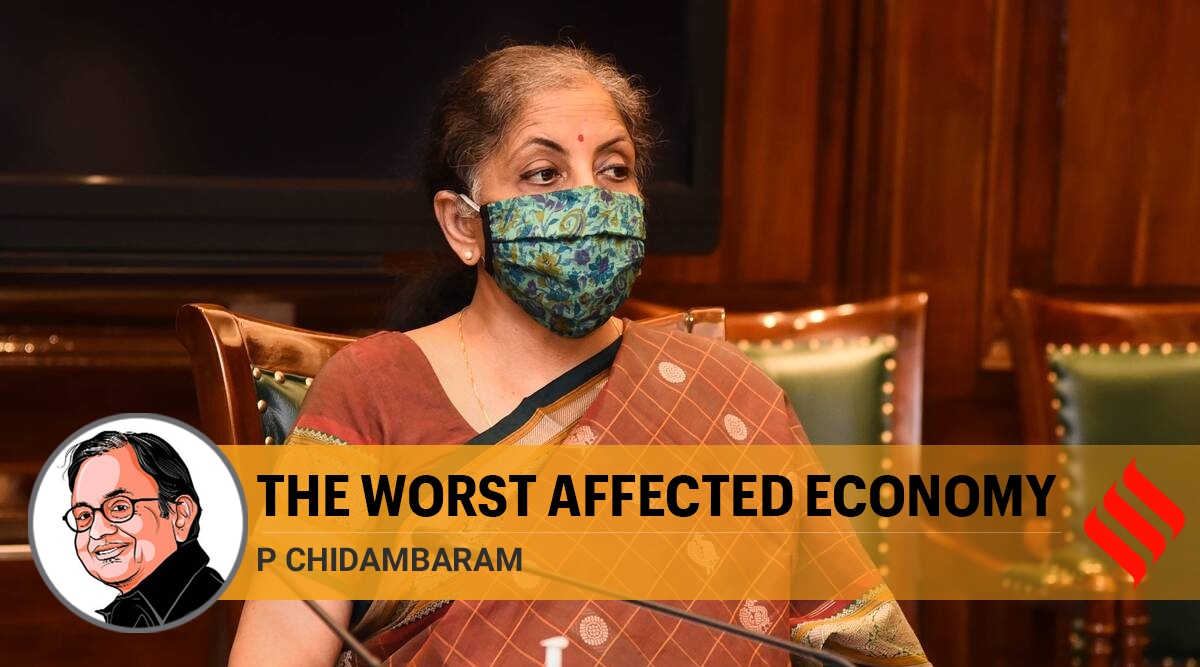
    The worst affected economy

    In a barren desert without any sign of water, the Finance Minister and the Chief Economic Adviser saw green shoots!

     Written by P Chidambaram | Updated: September 6, 2020 2:04:26 pm 

    Source : https://indianexpress.com  

    india economic slowdown, india gdp fall, india gdp data, act of god nirmala sitharaman, covid 19 impact on indian economy, p chidambaramFinance Minister Nirmala Sitharaman at the fourth edition of Business Reform Action Plan. 

    Finally, the fake narrative that was peddled by the government through 2019-20, and even thereafter, has been exploded by the Central Statistics Office (CSO). Those are indeed harsh words in a column but the realities are harsher, the disdain of an uncaring government is so provocative, and the suffering of the people is so enormous that one is compelled to use harsh words. The intention is not to cause offence but to sound a loud wake-up call to those who are in power and those who support those in power.

    The provisional estimates of GDP for the quarter April-June 2020 (Q1 of 2020-21), released by the CSO, tell us a grim tale. GDP in the first quarter has declined by a whopping 23.9 per cent. That means, about one quarter of the gross domestic output as on June 30, 2019, has been wiped out in the last 12 months. Note that when output is lost, the jobs that produce that output are lost, the income that those jobs provide are lost, and the families that depend on those incomes suffer. According to estimates made by the CMIE, between the economic slowdown and the pandemic, at its peak, 121 million jobs were lost. These included regular salaried jobs, casual jobs, and self-employment. If you wish to do a reality check, just look around or ask questions of other households in your street or neighbourhood.

    At 23.9 per cent, India is the worst affected major economy (among the G-20) in the period April-June, 2020 (source: IMF).

    Don’t Blame God

     The only sector that has grown is Agriculture, Forestry and Fishing at 3.4 per cent. The Finance Minister who blamed an ‘Act of God’ for the decline should actually be grateful to the farmers and the gods who blessed the farmers. Every other sector of the economy has declined sharply, some precipitously. Manufacturing is down 39.3 per cent; Construction by 50.3 per cent; and Trade, Hotels, Transport and Communications by 47.0 per cent.

    The estimates did not come as a surprise to any one who has closely observed the Indian economy. What we have is an economic tragedy. It was foretold by many economists, most recently by the RBI in its Annual Report released last week. Look at the salient conclusions of the RBI:

    – High frequency indicators that have arrived so far point to retrenchment in activity that is unprecedented in history;

    – the total stimulus package (liquidity and fiscal measures) for G20 countries averaged 12.1 per cent of GDP (5.1 per cent of GDP for EMEs and 19.8 per cent of GDP for AEs). India’s fiscal stimulus was about 1.7 per cent;

    – the shock to consumption is severe, and it will take quite some time to mend and regain the pre-Covid-19 momentum; and
    – a majority of respondents (in an RBI survey) reported pessimism relating to the general economic situation, employment, inflation and income.

    Slide Predates Pandemic

    The Indian situation is different from other countries’ because our economic slide started long before the first case of Covid-19 was identified. Our slide started with demonetisation. For eight successive quarters in 2018-19 and 2019-20, GDP growth declined every quarter, from a high of 8.2 per cent to a low of 3.1 per cent. This point was made a zillion times, but the government pretended that India was the ‘fastest growing economy in the world’! And in a barren desert without any sign of water, the Finance Minister and the Chief Economic Adviser saw green shoots!

    We are still in a dark tunnel. Many economists believe that we can find our way out of it, even at this stage, if the government took the fiscal measures necessary to arrest the slide, boost demand/consumption, and, consequently, revive production and jobs. The key is expenditure — government and private consumption expenditure. It does not matter how much is spent under which head as long the money is found and spent. The government can find the money from many sources — disinvestment, more borrowing by relaxing the limits under the FRBM Act; using the generous funds to fight the pandemic promised by the IMF, World Bank Group, ADB and others (USD 6.5 billion); and, as a last resort, monetising part of the deficit.

    Three Bold Moves

    Part of the money must be transferred in cash to the poor; part should be used for government capital expenditure in infrastructure; part used to bridge the GST compensation gap; and part used for re-capitalising banks and enabling them to lend. Once there is an indication of revival of demand, private corporates, that are cash-rich and have de-leveraged, will invest and produce.

    The next bold move should be to use the mountain of food grain to put food in the homes of poor families and to pay wages-in-kind to start massive public works. The godowns will be full again soon thanks to the record-breaking harvest expected this year.

    The third big move will be to decentralise powers to the states and empower them financially. The Centre should abandon its ill-timed attempt to interfere with agricultural produce marketing, regulate supply of essential commodities, and control district central and urban cooperative banks. One Nation, One Everything is a very bad idea.

    My proposals do not factor two unknowns — the course of the pandemic and the intentions of China —because, as I write, they remain unknowns.

    DoPT Clarification on VRS received from Persons With Disabilities


    Inter-seniority of IPoS Group 'A' officers of 2015 batch

    Confirmation of the officers in the Junior Time Scale of Indian Postal Service, Group 'A'

    CHQ writes to Directorate on counting of training period for financial upgradation under MACP Scheme


    NFPE requests D G (Posts) to consider waiver of recovery from the ex-gratia of GDS-reg


    Extremely Sad News : Com. Umakanta Lenka, Postmaster, Balasore HO no more

    We are extremely disheartened to know the sad demise of  Com. Umakanta Lenka, 56, Postmaster, Balasore HO on 07.09.2020 morning.

    As ascertained, Com. Lenka was on leave since last 10 days and under treatment for typhoid. Today (07.09.2020) morning, he experienced breathing problem and was admitted to Balasore District Headquarters Hospital where  the doctor declared him as dead.

    Com. Lenka has been left with his wife, one college going son and one college going daughter.


     On his death, Odisha Postal Circle lost a very dynamic Postmaster and NFPE lost one of its branded  bonafide comrades. Com. Lenka will be remembered for his devotion to duty, sincerity, integrity and belongingness both towards the Department and staff members. Though Com. Lenka primarily belongs to Balasore Division, he has successfully worked as Postmaster Baripada HO under Mayurbhanj Division and Postmaster, Bhubaneswar-2 MDG under Bhubaneswar Division before joining as Postmaster, Balasore HO. During his tenure as Postmaster, Baripada HO (2017), AIPEU, Group-C, Mayurbhanj Division has felicitated him as the best Postmaster  in the presence and participation of the Circle Secretary, AIPEU, Group-C, Odisha Circle.


    Deeply saddened, we, on behalf of NFPE, Odisha pay our respectful homages and convey our sincere condolences to the bereaved family members.

    We pray Lord Jagannath to give courage to the bereaved family members to bear with this  irreparable loss.

     We also appeal our Divisional Secretary and other members to stand with the family and extend all possible help at this critical moment.

    Let the divine soul rest in peace.

    NFPE writes to Department on misguidance to members of public by IPPB in sale of BALIC products in the brand name of India Post and harassment to DoP Staff on deputation to IPPB


    IMPORTANT SUPREME COURT JUDGEMENT ON GRATUITY TO GDS AFTER RESIGNED TO THE POST

     CLICK HERE  FOR COPY OF JUDGEMENT (18 PAGES)

    HEALTH MINISTRY ISSUES UPDATED ADVISORY ON COVID-19 TESTING

    SIMPLIFIED TESTING PROCEDURE AND ‘ON-DEMAND’

    TESTING FOR THE FIRST TIME


    Posted On: 05 SEP 2020 11:35AM by PIB Delhi

    There has been an unprecedented upsurge in India’s daily testing capacities. For two successive days more than 11.70 lakh tests have been conducted per day. A total of 4 crore and 77 lakh tests have been done so far across the country. There are now 1647 testing laboratories operational which cover all States/UTs. It is in this background that the Health Ministry has issued the updated Testing Advisory. 

    On recommendations of the National Task Force on COVID-19, the new Advisory has further simplified the testing process and given more freedom and flexibilities to the State authorities to facilitate enhanced ease of testing for the people.

    For the first time, along with more simplified modalities, the updated Guidelines provide for ‘On-demand’ testing in order to ensure higher levels of testing.

    The Advisory elaborates on the choice of tests (in order of priority) in various given settings.
    1. Routine surveillance in containment zones and screening at points of entry:
    Choice of Test (in order of priority):
    1. Rapid Antigen Test (RAT) [as per attached algorithm]
    2. RT-PCR or TrueNat or CBNAAT

    1.    All symptomatic (ILI symptoms) cases including health care workers and frontline workers.

    2. All asymptomatic direct and high-risk contacts (in family and workplace, elderly ≥ 65 years of age, immune compromised, those with co-morbidities etc.) of a laboratory confirmed case to be tested once between day 5 and day 10 of coming into contact.

    3. All asymptomatic high-risk individuals (elderly ≥ 65 years of age, those with co-morbidities etc.) in containment zones.

    1. Routine surveillance in non-containment areas:
    Choice of Test (in order of priority):
    1. RT-PCR or TrueNat or CBNAAT
    2. Rapid Antigen Test (RAT)*

    4. All symptomatic (ILI symptoms) individuals with history of international travel in the last 14 days.

    5. All symptomatic (ILI symptoms) contacts of a laboratory confirmed case.
    6. All symptomatic (ILI symptoms) health care workers / frontline workers involved in containment and mitigation activities.

    7. All symptomatic ILI cases among returnees and migrants within 7 days of illness.

    8. *All asymptomatic high-risk contacts(contacts in family and workplace, elderly ≥ 65 years of age, those with co-morbidities etc. [RAT is recommended as the first choice of test in order of priority]
    1. In Hospital Settings:
    Choice of Test (in order of priority):
    1. RT-PCR or TrueNat or CBNAAT
    2. Rapid Antigen Test (RAT)

        9. All patients of Severe Acute Respiratory Infection (SARI).

    10. All symptomatic (ILI symptoms) patients presenting in a healthcare setting. 11. Asymptomatic high-risk patients who are hospitalized or seeking immediate hospitalization such as immunocompromised individuals, patients diagnosed with malignant disease, transplant patients, patients with chronic co-morbidities, elderly ≥ 65 years.
    12. Asymptomatic patients undergoing surgical / non-surgical invasive procedures (not to be tested more than once a week during hospital stay).
    13. All pregnant women in/near labor who are hospitalized for delivery.

    Points to be noted:

    ·                   No emergency procedure (including deliveries) should be delayed for lack of test. However, sample can be sent for testing if indicated as above (1-13), simultaneously.
    ·                  Pregnant women should not be referred for a lack of testing facility. All arrangements should be made to collect and transfer samples to testing facilities.
    ·                Mothers who test positive for COVID-19 should be advised to wear a mask and undertake frequent hand washing while handling their baby for 14 days. They should also be advised on breast cleaning before feeding the neonate. These measures are likely to reduce transmission of COVID-19 to their babies.

    14. All symptomatic neonates presenting with acute respiratory / sepsis like illness. (Features suggestive of acute respiratory illness in a neonate are respiratory distress or apnea with or without cough, with or without fever. Neonates may also manifest with only non-respiratory symptoms like fever, lethargy, poor feeding, seizures or diarrhea).
    15. Patients presenting with atypical manifestations [stroke, encephalitis, hemoptysis, pulmonary embolism, acute coronary symptoms, Guillain Barre syndrome, Multiple Organ Dysfunction Syndrome, progressive gastrointestinal symptoms, Kawasaki Disease (in pediatric age group)] based on the discretion of the treating physician.
    A totally new section has been added in the Advisory on “Testing on Demand” which for all practical purposes does away with prescription by a registered medical practitioner although State governments have the freedom to decide on simplified modalities.
    The new section reads thus-
    1. Testing on demand (State Governments to decide simplified modalities):
      1.  
        1. All individuals undertaking travel to countries/Indian states mandating a negative COVID-19 test at point of entry.
        2. All individuals who wish to get themselves tested.
    Tracking and contact tracing mechanisms should be ensured by the testing laboratories by notifying the public health authorities.

    Frequency of testing :

    ·         A single RT-PCR/TrueNat/CBNAAT/RAT positive test is to be considered confirmatory, without any repeat testing.
    ·         No re-testing is recommended prior to discharge from a COVID-19 facility after clinical recovery (please refer to MoHFW guidelines), including for transfer from a COVID area/ facility to a non-COVID area/ facility.
    ·         If symptoms develop following a negative RAT test, a repeat RAT or RT-PCR should be done (Algorithm for interpreting RAT is placed at Annexure 1).

    Points to be noted:

    ·         WHO case definition for ILI: Individual presenting with acute respiratory infection with fever
    ≥ 38◦C AND cough with onset within the last 10 days.
    ·         WHO case definition for SARI: Individual presenting with acute respiratory infection with history of fever ≥ 38◦C AND cough with onset within the last 10 days AND requires hospitalization.
    ·         All healthcare workers and frontline workers coming in contact with suspect/confirmed COVID-19 patients should ensure use of appropriate PPE.
    ·         Home quarantine for 14 days is recommended for all individuals before undergoing elective surgery to minimise chances of infection before the procedure.


    For all authentic & updated information on COVID-19 related technical issues, guidelines & advisories please regularly visit: https://www.mohfw.gov.in/ and @MoHFW_INDIA.
    Technical queries related to COVID-19 may be sent to technicalquery.covid19@gov.in and other queries on ncov2019@gov.in and @CovidIndiaSeva .
    In case of any queries on COVID-19, please call at the Ministry of Health & Family Welfare helpline no.: +91-11-23978046 or 1075 (Toll-free). List of helpline numbers of States/UTs on COVID-19 is also available at

    MV/SJ HFW/COVID Advisory/5September2020/1 (Release ID: 1651508)

    Advisory on Strategy for COVID-19 Testing in India (Version VI,dated 4thSeptember 2020) Recommended by the National Task Force on COVID-19